
Why B2B Companies Need Inbound Marketing
There is no shortage of international content on Inbound Marketing, yet most companies in China are still in the early stages of understanding what it actually means — which is exactly why it is worth explaining from the ground up.
Compared to their counterparts in North America and Europe, many companies in China have been slower to embrace advanced marketing philosophies and the digital tools that support them. Multinational corporations, however, have accelerated this shift by pushing their local subsidiaries to adopt digital marketing frameworks — including Inbound Marketing — and to leverage software as a lever for operational efficiency. As a result, a growing number of leading Chinese enterprises have begun to experience the impact of these approaches firsthand. Even so, most organizations that are aware of Inbound Marketing are still at a foundational level of understanding, which is precisely why it is worth starting with the basics.

What Is Inbound Marketing?
Inbound Marketing is a methodology best described by its English definition: “pulling your customer in.” The approach has been translated into Chinese in various ways — capturing nuances that range from “attracting customers” to “drawing prospects in” to “arrival marketing.” And yes, if there is Inbound Marketing, there is naturally Outbound Marketing — defined as “pushing your message out.” Outbound is, as the name suggests, broadcast-oriented: the brand pushes content out regardless of whether the audience is ready or interested.
In this article, Knight finds it helpful to use the “arrival” framing as an analogy. Imagine your company website as an international airport terminal. Visitors arriving from different countries represent potential customers coming from different channels. Each of these visitors lands on a different runway — these runways are your landing pages, where your marketing content first greets them. As travelers make their way through customs (your qualification and nurturing steps), you begin to distinguish who is merely in transit and who is ready to stay and engage. Your job as a marketer is to convert transit passengers into arriving visitors, and to encourage those already arriving to explore and spend more. The better you understand each traveler’s preferences, purchasing behavior, and background, the more precisely you can influence their decisions — and that is the essence of digital marketing. Our Beginner’s Guide to Content Mapping can help you put this concept into practice.
For any marketing operation, true end-to-end coverage looks like this:
The Closed-Loop Marketing System
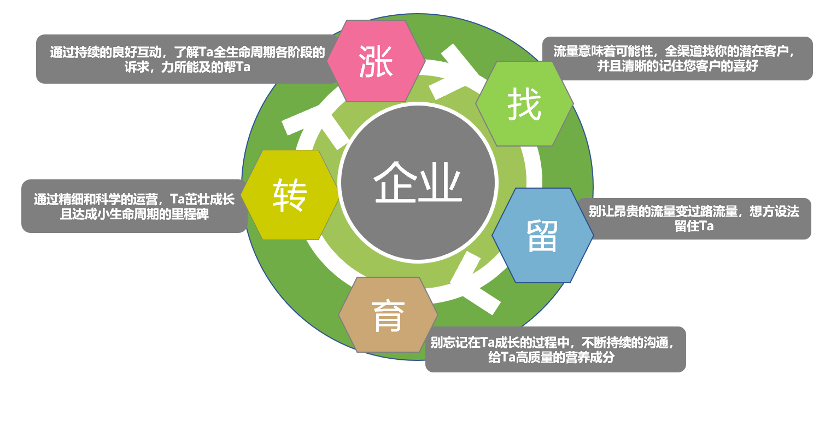
Modern marketing brings this closed loop to life through the principles of inbound:
The Three Stages of Inbound Marketing — Your Marketing Should Be a “Flywheel,” Not a “Funnel” (Part 1): Attract → Convert → Grow
While the Convert stage sits at the heart of inbound, the journey from anonymous visitor to paying customer typically follows a clear progression:
Visitors → Prospects / MQLs → SQLs → Customers
Inbound marketing holds that the right way to move prospects along this journey is through content that is substantive, educational, and genuinely useful — delivered in layers that deepen as prospects move closer to a decision. In the Visitors stage, companies might publish authoritative industry guides or e-books. At the Prospect stage, best practice articles and case studies are more appropriate. By the SQL stage, the conversation shifts to concrete offers and typically calls for direct Sales Rep involvement. After conversion, the customer lifecycle continues into repeat purchase and advocacy phases — topics we will explore in future content. Stay tuned to Knight for more.
The Foundation of Inbound: Content Marketing
Any serious discussion of inbound marketing must begin with content marketing — it is the operational backbone of the entire approach.
To create content that resonates with your audience, you must first understand them deeply.
That means gathering data across multiple dimensions to build detailed buyer profiles — profiles that illuminate purchasing habits, key concerns, and decision-making triggers. With that understanding, you can attract the right prospects and ensure that your products or services are discoverable wherever your buyers are looking.
Finding it harder than expected to create content that speaks to a wide audience? How to Build a Winning Content Marketing Strategy can help you get there.
The articles, whitepapers, videos, and interactive experiences you produce should meet prospects where they are — tailored to their stage in the buyer journey and delivered through the right channel at the right moment. Precise, differentiated distribution is what turns a casual browser into a qualified lead: it is the difference between a traveler glancing at a duty-free catalog on the plane and one who walks into the terminal, fills out their arrival card, and proceeds to explore and spend.
Once your content plan is in place, the next step is distributing your offerings across every available touchpoint — landing pages, in-terminal displays, entry checkpoints, and beyond. Cast as wide a net as possible across every scenario you can imagine; you might even consider “selling in the cabin” — delivering your pitch earlier in the journey to shorten the path to conversion. Throughout this process, different prospects will respond to different content in different ways. That demands real-time feedback loops and the ability to trigger automated, contextually appropriate follow-up — capabilities that are virtually impossible to deliver at scale through manual effort alone. That is precisely why companies choose Knight.

A note from Knight:
In an era where digital marketing is no longer optional, are you still relying on push-based outreach? — “Inbound Marketing” vs. “Outbound Marketing”. Outbound tactics have earned widespread criticism for being intrusive, high-volume, and low-relevance. So what does it actually look like to reach the right customers and show them exactly what they need?
The answer is in the opening lines of this article: stop chasing your customers. Instead, demonstrate your value so compellingly that they come to you.