
What Exactly Is Content Marketing?
When I talk with marketing colleagues at client companies, they often say: "Oh, I handle marketing — we have a separate team for operations." That response never fails to leave me speechless. What immediately comes to mind is: "So what exactly are your SEM/SEO campaigns, your WeChat account, your website, your social channels doing?" None of those channels can produce results without content. Before you call yourself a marketer, do one thing first: get clear on the purpose and desired outcome of the content you publish on every channel. All marketing is built on content, and every marketing action should be underpinned by a coherent, end-to-end customer-acquisition logic.
As the Knight user base continues to grow, so does the number of clients asking what content marketing really is — and how to do it well. That’s why we decided it deserved its own dedicated article.
In conversations with marketing colleagues at client companies, I often hear something like: “Oh, I’m in charge of marketing — we have a separate person who handles operations.” Every time I hear that, my jaw drops. What immediately comes to mind is: “So what are your SEM/SEO campaigns, your WeChat Official Account, your website, your self-media, and your social channels actually doing?” None of those channels can function without content. So before anything else, please do one thing: get crystal clear on the purpose and the desired outcome of the content you push on each channel. Only then can you truly say you’re responsible for marketing. All marketing is built on content, and every single marketing action should be backed by a rigorous, end-to-end customer-acquisition logic — What Is Marketing Automation.

Of course, the forms content can take is a separate conversation. When someone first asks “what is content marketing?”, it can feel like one of those questions where you scratch your head and struggle to find the words. But let me put together an example (I’ve been a long-time user of a certain map app, so consider this a free plug): Imagine you see a video going viral on your social feed. It tells the story of a young man from a small town who moves to a big city after graduating college, searching for his first job. Far from home, with no friends or family nearby, the journey is lonely and grueling. Because he’s new to the city, he relies on a map app for everything — navigation, transit routes, finding nearby accommodation. After countless setbacks, he finally lands the job that lets him chase his dreams. Summoning his composure, he calls his mother to let her know he’s safe. His worried mom asks: “Son, do you know your way around?”
He replies: “Don’t worry, Mom — I’ve got [the map app]. It’s got me covered for everything.” End scene.
That story is content marketing in action. The video is touching, uplifting, and captures the warmth of a parent’s love — it never feels like an ad (and even when you know it is, it still moves you). It resonated with hundreds of millions of viewers and spread virally. That’s the distribution effect achieved. At the same time, the map app’s brand and functionality were communicated with genuine emotion. Compelling content with a naturally embedded brand message — “content + marketing” achieved seamlessly. This example gives you a broad-strokes picture of what content marketing looks like at the output level. Practitioners, however, should pay far more attention to the operational process that drives those results. (SEM/SEO, websites, corporate live streams, WeChat Official Accounts, Weibo, Zhihu, Douyin, Toutiao, Jianshu, and platforms like “Everyone Is a Product Manager” are all expressions of content marketing!)
As the saying goes: outsiders watch the spectacle; insiders make the spectacle. If you’re the head of your marketing team, it’s time to take ownership of the content and plans you’re about to execute. Here’s a process overview we’ve put together:
1. Find Your Niche
A niche market refers to a segmented or specialized subset of the broader market that dominant players tend to overlook. Simply put, it’s your market — the space where you lead and set the terms. The goal is to avoid head-on competition: rather than plunging into whatever industry looks trendy and hoping to stand out, find the corner of the market where you can genuinely win.
Identifying your niche can be thought of as a competitive dimension analysis. Free tools you can leverage include search engine analytics, social media analytics platforms, and industry reports. In practice, many companies dive into a sector first and then use these online tools to conduct competitive analysis afterward.
2. Customer Persona Analysis
Building customer personas is essentially the process of researching user needs. Your business will never serve just one type of customer — your audience is diverse, and different segments will have different needs. For example, segmenting by gender alone reveals that male and female users often have completely different expectations of your product (generally speaking, men prioritize functionality while women prioritize aesthetics). You’ll need different content to engage each group. Each persona represents a distinct need profile, so the work here is to categorize those needs, identify the topics each type of customer cares about, and use that as the foundation for your content planning.
3. Content Planning — See Also: How to Plan a Successful Content Marketing Strategy
Thorough content planning upfront is the only way to avoid getting lost later in the sheer variety of content formats available. It keeps you anchored to the overall framework and direction, guiding what you should actually be creating. A content planning matrix should cover three dimensions: customer persona, stage of the buyer lifecycle, and content format. Example:
| Market Awareness | Consideration | Evaluation & Comparison | Decision | |
|---|---|---|---|---|
| Persona A | Introductory overview | Product comparison guide | Customer case study (short) | Buying guide |
| Persona B | Thought leadership | Industry solution brief | Product demo | |
| Persona C | Introductory whitepaper | Industry whitepaper | ||
| Persona D | Brand video | Webinar | Customer case study (video) |
Content planning is an iterative process — it requires continuous optimization and adjustment throughout execution.
4. Content Production
Once the preceding steps are in place, you can finally roll up your sleeves and get into production. This is usually the most time-consuming phase and needs to be sustained over the long term. Written content is typically the foundation, and from there you can branch out into a wide variety of formats. Example:
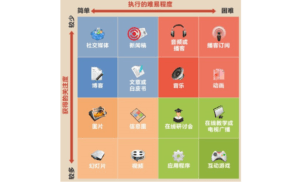
5. Content Distribution and Promotion
Publishing content to your own channels is just the beginning — you also need to leverage third-party platforms to amplify your reach and draw audiences back to your owned properties. For example, after writing a high-value article, you should distribute it to industry portals, vertical media sites, Zhihu, WeChat, blogs, and other channels to drive traffic and build brand awareness.
One important note: content should be released with a cadence. Don’t produce a large batch of content and push it all out at once. Instead, test and release incrementally, observe the response, and adjust your strategy along the way.
6. Monitoring and Follow-Up — Let Knight Help You Get There
Measuring the ROI of content marketing has always been a challenge, but as technology advances, more and more indicators can be quantified — which is a major reason why traditional full-service ad agencies have struggled to stay relevant in recent years. Common hard metrics include traffic volume, branded search index, bounce rate, comment count, and share count. Of course, these metrics are reference points rather than definitive verdicts; ongoing refinement based on real business outcomes is essential, and human judgment will always play a role.
Beyond metrics, you also need to continuously monitor and manage your published content. For instance, a single sensitive negative comment can escalate into a brand crisis — which means you need a system alert mechanism in place so you can engage with the commenter promptly and defuse the situation before it spirals.
Knight Pro Tip:
Content marketing is far more than producing a creative viral video. At a high level, it operates in a continuous cycle: analysis → content planning → content production → content deployment → performance evaluation. And the relationship between each phase isn’t simply sequential — there’s significant overlap and recombination at every stage. Every piece of content produced through this process should have a clear call to action (CTA) — fill out the form to access the full Lead Scoring Playbook (Part 1) — and the strategic thinking behind it naturally drives strong outcomes (customers need to be nurtured with precision). Naturally, the steps outlined above require far more operational detail to implement effectively, and best practices will vary by industry.