Your Marketing Should Be a "Flywheel," Not a Funnel (Part 1)
Walk through any modern office building, ride an elevator, or sit in a client's conference room, and you are bound to hear the word "funnel." For years, companies have built their go-to-market strategies around the funnel — and it worked. But increasingly, marketers, salespeople, and business leaders are finding it falls short. Customer referrals and word-of-mouth are now the single biggest driver of purchase decisions, which exposes the funnel's critical blind spot: it treats the customer as an end result, not as the most powerful growth engine available. The funnel is designed to generate customers — not to leverage them. That is exactly why it is time to switch to the Flywheel model.
Today’s article is about helping you make the shift from the Funnel model to the Flywheel model — a shift that can accelerate business growth and meaningfully improve customer satisfaction. At Knight, we believe that in the age of AI, the “Customer Internet” has taken center stage. A customer-centric approach is no longer optional; it is the defining competitive force of our era. And if customers are that important, then a single genuine recommendation from a satisfied client is worth more than a thousand words of marketing copy. So why not put customers at the very core of your growth engine?
Walk through any modern office building, ride an elevator, or sit in a client’s boardroom, and you are almost certain to hear the word “funnel.” It shows up on whiteboards, in strategy decks, in sales kickoffs. For years, businesses built their commercial strategies around the funnel — and it delivered results. But lately, marketers, salespeople, and business leaders alike have started finding it disappointing. The reason is straightforward: customer referrals and word-of-mouth have become the single most influential factor in the purchase process. That reality exposes the funnel’s fundamental flaw — it treats the customer as an outcome rather than as the most powerful growth driver in your arsenal. The funnel is engineered to produce customers; it is not engineered to leverage them. That is precisely why businesses need to make the transition to the Flywheel model.
What Is the Flywheel?
Unlike the funnel, a flywheel is exceptionally good at storing and releasing energy. (Flywheel energy storage is commonly used in wind power generation, where the flywheel is the core component converting electrical energy into kinetic energy.) Now imagine having a flywheel at the center of your marketing strategy — the implications are significant. The flywheel, originally invented by James Watt, is a remarkably energy-efficient mechanism. The amount of energy it stores depends on three things: how fast it spins, how much friction it encounters, and how large it is. When you think about growing a business, this model is extraordinarily useful.
Under the traditional funnel model, customers were simply a marketing output. If the deal closed, the effort was worth it (assuming it was a profitable one). If the prospect never converted, every resource invested in them was wasted — a bucket with no water to show for it.
The Flywheel model changes that dynamic entirely. It allows you to harness the momentum of loyal, satisfied customers — through repeat purchases and referrals — to sustain and compound your business growth. When you shift from a funnel to a flywheel, your entire strategy evolves with it. Let’s start with a side-by-side comparison:
From Funnel to Flywheel
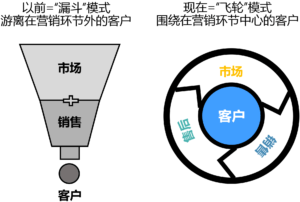
How Does the Flywheel Model Work?
As mentioned at the outset, the energy and momentum your flywheel generates depends on three factors:
- How fast the flywheel is spinning
- How much resistance or friction it encounters
- How large the flywheel itself is
The most successful companies actively tune their business strategy to address all three. The flywheel spins faster when you apply force at the highest-impact points — for example, your customer success team or post-sale service team. When you invest more in the areas that matter most (such as customer service), the flywheel accelerates. By focusing on helping your customers succeed, you generate stories of success that naturally reach and influence future prospects.
Keep in mind that even companies within the same industry can have very different business models. How you design your flywheel must reflect your own commercial reality. Identify the teams and functions that have the greatest impact on your company’s growth, customize the flywheel to fit your business, and use data-driven insights to apply leverage where it counts most.
Once you are actively driving the flywheel, your next priority is eliminating anything that works against it — in other words, identifying and removing friction from your strategy. You can reduce friction by examining whether your team structure and capabilities are well-suited to your goals, understanding why customers churn, and diagnosing where prospects get stuck along the buying journey. Are your teams aligned around a shared set of business objectives? Is your pricing transparent and straightforward, or is it cluttered with opaque fees and hidden conditions? Do you make it easy for prospects to reach you on their terms — in their preferred channel, at their preferred time — or do you force them to navigate your internal processes?
Reducing friction while increasing force at the right points creates more business momentum. Every improvement compounds, contributing to a larger, faster-spinning flywheel.
Inbound Marketing Methodology and the Flywheel — Learn more: What Is Inbound Marketing
You may be wondering how inbound marketing methodology maps onto the Flywheel model. Inbound marketing is built on the principle of earning customer trust through honest, comprehensive, and transparent communication about your product or service — whether that means sharing your methodology, pricing, features, or support offering. The goal is singular: build genuine trust. The flywheel then amplifies that trust by transforming delighted customers into advocates who expand your reach and reinforce your reputation.
At Knight, we believe deeply in this philosophy. It is why we realigned our entire company around the flywheel model — and why we want to share how you can apply it to grow your business. This is also why inbound marketing is an ongoing, self-reinforcing cycle. Its focus is on building a flywheel that attracts customers, engages them meaningfully, and leaves them genuinely delighted — a truly customer-centric model. Of course, making inbound work requires that every member of your team shares a clear, unified understanding of your goals, so you can deliver an outstanding experience at every stage of the customer journey.
Continue reading: Your Marketing Should Be a “Flywheel,” Not a Funnel (Part 2)