The Night Economy Is Here: Three Steps to Break Through This New Consumer Battleground
The real battleground for new retail and new consumption is increasingly looking like nighttime.
There is a narrow back alley in Tokyo’s Shinjuku district. Tucked inside it is a small diner that operates from midnight to seven in the morning — a place regulars have come to call the “Midnight Diner.”
The menu is bare-bones: pork miso soup sets, beer, sake, and shochu, with a three-drink limit per guest. But as the owner puts it, if you dare to order it, he’ll make it — ochazuke, octopus with red sausage, cat rice, you name it.
One line from the story has become a kind of mantra: “There’s nothing a good meal can’t fix. And if there is, two meals will do.”

That spirit has since crossed into China.
Beijing recently announced that designated “Midnight Diner” dining districts can receive up to five million yuan in government support, and individual “Midnight Diner” establishments can receive up to 500,000 yuan. Meanwhile, at least 13 provinces and cities across China — including Shanghai, Tianjin, Chengdu, and Jinan — have rolled out policies to stimulate their local night economies.
If you’re not out enjoying yourself after work, the government is worried on your behalf.
The people who linger into the small hours carry with them an unwillingness to call it a day. Their wandering, their appetite for spending, their desire for self-expression — all of it is carving out a powerful new market opportunity.
So if the hours after 6 p.m. represent a new consumer frontier, how should brands and businesses position themselves?
1、Impulse Buying Is Back
The night economy is, in many respects, a form of consumption that runs counter to e-commerce logic — call it “reverse e-commerce.” Here’s what that means.
Take a product like chewing gum. It thrives on impulse. Most gum is placed right next to the checkout counter at supermarkets, so customers toss it in as an afterthought when they’re paying. Similarly, a skewer stall at a tourist attraction works because it sits right on the path — visitors walk by, catch the smell, and buy on a whim, without much deliberation.
Online shopping is the opposite. Consumers compare prices obsessively, scroll through user reviews, trust peer ratings over brand names, and deliberate endlessly before clicking “buy.” That process has essentially killed the impulse purchase — and for offline businesses, it has been nothing short of devastating.
But the rise of the night economy has brought impulse buying back to life.
Part of it is stress relief. Young people today are living the “996” lifestyle — working from 9 a.m. to 9 p.m., six days a week. The longer the workday, the greater the need to decompress at night. Grabbing dinner with friends, having a few drinks at a bar, or singing karaoke has become a new normal for China’s urban youth.
Part of it is also about loneliness. Research suggests that over the course of a lifetime, a person encounters some 8.26 million others — they’ll greet about 39,778 of them, become acquainted with around 3,619, and grow close to about 275. Yet almost all of those connections eventually fade. Too often, you find yourself eating alone, shopping alone, spending alone. It sounds bleak. But nobody can live like an island — lasting happiness always traces back to meaningful human connection.
The night economy’s greatest asset is that sense of warmth and vitality. Night markets are where people congregate and spend freely, sometimes impulsively. Why does spending become more attractive when surrounded by a crowd? Because seeing others like yourself reassures you that you’re not alone.
The deepest driver of consumer spending is rarely satisfying a material need. More often it’s about chasing connection — the feeling of being truly understood. Nighttime consumption is largely emotional consumption. It demands more than bright lights and foot traffic; it needs people who get you. What makes you love a city is the feeling that everything you’re looking for is already there, waiting to be found.
2、What Really Tests Your Business Instincts?
The night economy doesn’t require a major metropolis to flourish. What matters most is your judgment and your ability to connect with customers on their own level.
Consider Gumii Tea, a now-famous Chinese tea brand. Ten years ago, it opened its first location in a small town in Taizhou, Zhejiang. Today it has thousands of stores. What was the secret to making a chain tea shop work in a small town?
No Silicon Valley guru or startup coach needed to hand down the answer. Any observant entrepreneur could have spotted it: in a small-town setting, the interior doesn’t need to be particularly upscale or polished, but the lighting absolutely must be bright — bright enough to serve as a landmark in the neighborhood.
In towns where ambient lighting is typically dim, a brilliantly lit storefront stands out immediately and signals cleanliness and quality to potential customers. That kind of small, sharp insight, accumulated over time, is what builds a distinctive brand identity.
One reliable indicator of a city’s night economy vitality is the density of its convenience stores — the ones that advertise 24-hour, year-round service.
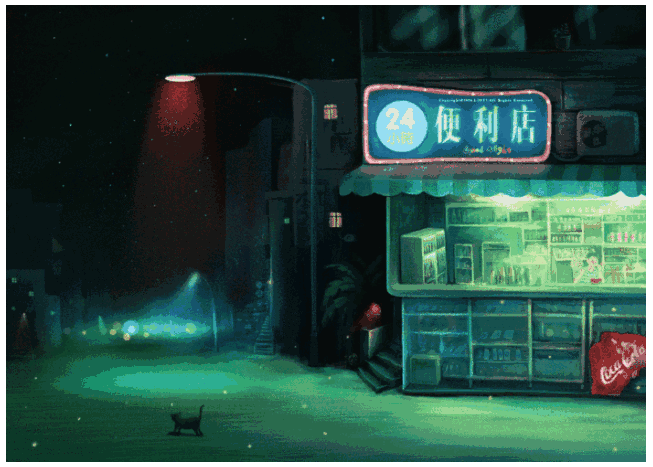
A couple of years ago, convenience stores were a hot space for entrepreneurs. Chains like Bianlifeng and Linjia expanded rapidly. Linjia, in particular, was hailed as the most 7-Eleven-like convenience store in China. Then its lead investor’s funding dried up, and Linjia — which had reached 168 locations in Beijing — collapsed almost overnight.
Convenience stores have broadly struggled to survive in Beijing. The city government set a target of 3,000 stores by 2020; Shanghai already has more than 5,000, and Guangdong’s Meiyijia chain alone operates over 10,000 outlets. Using 7-Eleven as a benchmark: Taiwan has more than 5,500 stores, Hong Kong nearly 1,000, and Beijing only around 250 — despite Beijing’s permanent resident population being roughly equal to all of Taiwan’s, and with far greater population density in its urban core.
Beijing’s convenience store coverage lags far behind Tokyo, Hong Kong, and Shanghai. For a long time, Beijing was written off as a “graveyard for convenience stores.”
Why? Observers point to what they call “three half-businesses.” First, roads are too wide — stores can only draw from half a street’s foot traffic. Second, winters are brutal and major political events periodically shut down the city, limiting effective trading to roughly half the year. Third, nightlife is sparse, which means stores only do meaningful business for half the day.
A major engine of night economy activity is street-level culture: ground floors lined with shops, residents flowing in and out, daily life played out along pedestrian-friendly corridors. Beijing, by contrast, is shaped by a “compound culture” — residents are organized around enclosed residential blocks of 800 to 1,000 households. Commerce clusters in isolated pockets rather than forming continuous commercial strips, making it hard to concentrate the warmth and buzz that a thriving night economy requires. The result is that only a handful of areas — Wangfujing being the most notable — have managed to build genuine nighttime destinations.
Beyond culture, night economies also depend on infrastructure.
London and Amsterdam — two of Europe’s most celebrated cities that never sleep — both benefit from active municipal support. London’s famous Night Bus network includes at least 52 overnight routes. As the city grows, buses alone aren’t enough: in 2016, London’s government launched all-night Tube service on Fridays and Saturdays, and five of London’s 11 underground lines now run through the night on weekends.
Amsterdam took a different approach, appointing an official “Night Mayor” to mediate between the government, businesses, and local residents. The city has a curfew: clubs must clear their floors by around 4 or 5 a.m. But when a crowd of revelers is suddenly ejected after hours of dancing — calling cabs, milling about, chatting — the noise can quickly disturb nearby residents. The Night Mayor’s solution was to select 10 clubs in less residential parts of the city and grant them 24-hour licenses, distributing different nightlife experiences across different time slots and zones, balancing vibrancy with livability.
There is an international concept called the “Light Index”: the brightness of a region’s nighttime lights is directly proportional to its GDP. A city’s prosperity is more visible after dark than it is during the day.
3、New Consumption Means Winning the Probability Game
In recent years, “new retail,” “new consumption,” and “new manufacturing” have been talked about as the biggest business variables of our era.
In a previous piece on new retail’s pitfalls and opportunities, I noted that for any brand company, its biggest cost is that every pair of pants sold must absorb the production cost of three pairs — because the other two are sitting in inventory. Unsold stock and drawn-out payment terms have been the ruin of many businesses.
The way out of traditional retail’s chronic pain points may lie in new consumption. And new consumption is a night raid on the old order.
What defined traditional retail and consumption? Market segmentation and positioning.
In the old model, brands divided consumers by income, geography, age, social class, and taste, then precisely targeted each segment with a tailored product portfolio and sub-brand. This approach was largely effective at locking down distinct consumer groups.
Look at the world’s top FMCG conglomerates on the Fortune 500 — they have maintained portfolios of hundreds of sub-brands, each aimed at a different slice of the consumer pie.
Today, that playbook is running out of steam. Younger consumers are gravitating toward niche, social-media-native brands. Many of the major FMCG groups’ sub-brands have been quietly retired because they can no longer attract a large enough audience.
So where is the real competitive advantage of new retail and new consumption?
I believe it lies in winning the probability game.
Where are your customers? What will they want? When will they show up to buy? Traditionally, the answers were educated guesses — the quality of the guess varied, but it was always a guess. A brand’s value was largely its ability to increase the probability of being chosen. Yet even the strongest brand could never make that probability truly reliable.
New consumption offers something different — a genuine opportunity for brands to own that probability.
Step 1: Draw the Circle
Consider these data points, which illustrate how big data can help a business — or even a city or country — define its market boundaries:
-
A Ministry of Commerce survey on urban consumer habits found that 60% of total consumption happens in the evening. Major shopping malls generate more than half of their daily revenue between 6 p.m. and 10 p.m.
-
Beijing’s Wangfujing district sees peak foot traffic of over one million visitors per day — almost entirely at night. In Chongqing, two-thirds of all restaurant revenue is earned after dark. In Guangzhou, the night economy accounts for 55% of the entire city’s service sector revenue.
-
The iconic commercial hearts of China’s great cities are night markets: Beijing’s Sanlitun, Shanghai’s Xintiandi, Nanjing’s Fuzimiao on the Qinhuai River, Hong Kong’s Lan Kwai Fong, Macau’s Venetian.
-
The economic scale of the nighttime consumer market is staggering. According to research by TBR, an economic advisory firm, London’s night economy supports 1.3 million jobs and generates annual revenue of £66 billion — with a single city’s after-dark activity contributing 6% of the UK’s total national tax revenue. In the United States, residents already spend one-third of their time, one-third of their income, and one-third of their land area on leisure — and more than 60% of that leisure happens at night.
The pattern is unmistakable: the consumer market of the future will be won or lost in the hours after dark.
Step 2: Lock In
Night market districts like Wangfujing, Sanlitun, and Lan Kwai Fong are rare. The further you get from midnight, the more fragmented consumer demand becomes.
Data from the delivery platform Ele.me showed that between 10 p.m. and 9 a.m. the next morning, non-food orders placed to bars nationwide accounted for 24% of total orders during that window.
This reveals something important: nighttime consumption is about far more than eating and drinking. After-hours life surfaces latent needs that often go unnoticed during the day. After sweating it out on a dance floor, women may need makeup remover or contact lens solution; men may reach for antacids, throat lozenges, or hangover remedies. These are small, scattered, everyday needs.
Meeting so many micro-demands efficiently requires a system capable of intelligent, real-time resource allocation — in other words, a smart operational brain.
Meituan’s VP Wang Puzhong, who oversees its food delivery platform, is a case in point. A few years ago he managed a team of 20 people. Today, he effectively oversees 600,000 delivery workers — coordinated entirely by AI. During peak daytime hours, the system runs up to three billion delivery route calculations per hour. Late at night — even in the early hours of the morning — the platform continues dispatching orders and reallocating resources across large geographic areas.
A defining feature of new consumption is this: the fleeting impulse that sparks in your mind — the craving or need that might vanish in a few minutes — can now be captured by a system at any hour of the day, before it disappears, and converted into a completed transaction.
Step 3: Retain and Deepen
Both Walmart and Sears once held the title of America’s retail king. At one point their revenues were roughly equal — yet Walmart’s profits surged while Sears sank into losses. Same sales figures, wildly different bottom lines. Why?
The answer is simple: 40% of Walmart’s customers came back. For Sears, the return rate was under 10%. User retention is the source of profit.
The greatest value of a viral or trending destination is its ability to retain high-quality customers. Why do young people feel compelled to check in at the latest hot spot? Because that place becomes a psychological landmark in their lives.
Look at Tokyo’s Midnight Diner — buried deep in an alley, yet regulars keep coming back. That is, at its core, a landmark that has gone viral organically.
For any given consumer group, a trending destination is their psychological home base.
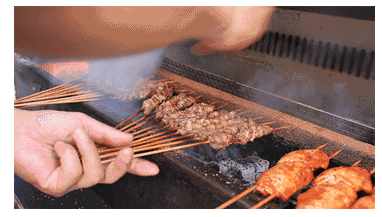
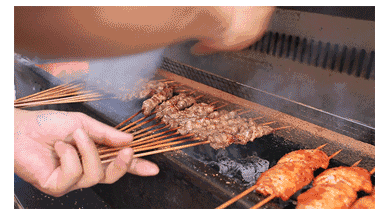
Chinese brands have tried to recreate the Japanese midnight diner experience domestically, but China’s version has never been about refined izakayas. It’s smoky barbecue joints, fried rice stalls piled with toppings, and noodle shops with a hundred different flavors — each one its own kind of institution.
Sometimes, people line up at a trending restaurant not even for the food itself, but for the content it generates — a photo for WeChat Moments, a short video for Douyin. A particular aesthetic has come to signal membership in a certain kind of life.
If everyone in your circle has been there and you haven’t, you feel like you’re missing something.
Many of these hot spots have waiting lists that stretch two weeks or more. That’s not just scarcity marketing — the level of enthusiasm has transcended ordinary commerce.
These destinations have tapped into a shift in urban social dynamics: online and offline merging, open and airy spaces, a slow and unhurried pace where people feel relaxed enough to open up and connect with one another. That is user retention with genuine warmth behind it.
As things stand, the real battleground for new retail and new consumption is increasingly looking like the hours after dark.
The new business models emerging from this era are no longer simply about capturing user traffic or creating new market opportunities. They are about claiming a higher-order competitive advantage — the probability edge.
When you have defined your customer base, built systems that can capture even the most fleeting consumer impulses without missing a beat, and created environments that retain users with genuine warmth and connection, the uncertainty inherent in business drops dramatically. You stop guessing. You stop paying the cost of being wrong. In fact, this may be the starting point of a genuine commercial revolution.
*This article is adapted from the WeChat public account “Li Meng.” Author: Li Meng, Founder and CEO of IMS (Influencer Marketing Specialist), a new media and commercial group.