
In the Age of 'Consumer Engagement,' Who Is Speaking for Your Brand?
We have entered the marketing era of 'consumer engagement.'
In the internet age, ordinary users have gained an unprecedented level of voice.
Taobao reviews, Xiaohongshu recommendation lists, Douyin (TikTok) marketing, Weibo word-of-mouth — the channels through which consumers can influence a brand’s public perception have multiplied. Users are no longer passive recipients of advertising; they are active forces shaping brand narratives. As consumers step out from behind the curtain and start speaking up, brands can no longer rely on one-way communication. This shift toward a two-way model — where users advocate for your brand — has given rise to the most powerful form of marketing today: viral, referral-driven growth.
The market is full of evidence. Challenges on Douyin drive UGC-fueled brand virality. WeChat Moments ads now feature open comment sections, leveraging social dynamics to capture group attention. And on Xiaohongshu and Taobao, livestreams by everyday users provide authentic, credible endorsements that professional brand messaging simply cannot replicate.
All of these models work because users are genuinely participating — and expressing their honest feelings about a brand.
This is the defining signal: we have entered the marketing era of “consumer engagement.”
What Is the Core Logic Behind Interactive Marketing?
To understand why engagement has become the central axis of modern marketing, we need to look at the underlying forces at play.
The first and most fundamental factor is information overload. As media theorist Marshall McLuhan observed, media is an extension of human sensory capabilities. With the rise of mobile internet, the volume of information consumers encounter daily has grown exponentially compared to just a few decades ago. From online to offline, we are bombarded with new content at virtually every moment. Simply being seen or heard is no longer enough — not in the way that early television once allowed brands to effortlessly plant messages in consumer minds.
This has led to a fundamental shift in marketing metrics. Engagement indicators — those requiring higher levels of user investment and participation — have become the new standard for measuring whether a brand message has genuinely landed.
In an environment of information saturation, brand communications that lack a participation layer risk being indistinguishable from the noise. Exposure alone is no longer sufficient to capture attention.
In this context, interactive engagement serves a dual purpose: it is both a mechanism for capturing deeper user attention and a proof point that users have formed a real impression of the brand. At the same time, the redistribution of narrative power in today’s media landscape is equally significant. Unlike earlier eras when people passively sat in front of screens, today’s users want to participate — not just be reached.
Evidence of this is everywhere. From the quantitative and qualitative review ecosystems on Taobao and Xiaohongshu, to ratings on Douban, commentary on Weibo, and the richly expressive short videos on Douyin — all of this demonstrates that users have developed a strong desire to engage with and comment on the world around them. In this environment, simple, one-way brand communication feels not just ineffective, but cold and out of touch. The success stories of brands like Durex and Haier on social media — and countless other official accounts thriving across platforms — all point to the same truth: what users want is a brand that feels like a partner, one that invites interaction and creates spaces for dialogue, not one that broadcasts a message and ignores the audience.

The shift in communicative power and the evolution of conversation formats have made interactivity a non-negotiable element of brand marketing strategy.
Beyond this, as narrative power has redistributed, individual users have themselves become transmission nodes — and brands that know how to activate these nodes can achieve outsized results with relatively modest effort.
From the wave of Vloggers and Instagram influencers overseas to the rise of KOCs (Key Opinion Consumers) domestically, the pattern is clear: people today are far more likely to trust and act on information that comes from someone who resembles them and whom they feel a genuine connection to, rather than from an official brand channel.
When the same message travels through a KOC — amplified by their personal brand and authentic voice — it carries far more warmth and relatability than polished corporate content. Compared to high-follower KOLs who can feel distant and aspirational, KOCs are closer to everyday users, which makes them feel more approachable and trustworthy. They have become the new grassroots transmission nodes of this era. And the collective communicative power these core users possess has fundamentally changed the relationship between brands and consumers.
What emerges from all of this is that modern marketing involves far more than just the brand and the consumer. Platforms and KOLs now function as nodes and amplifiers, forming a complex, multi-stakeholder communication network in which brands, users, platforms, and KOLs all interact dynamically.
Why Is Interactive Marketing So Difficult to Execute?
The advantages of interactive marketing are clear — but doing it well is anything but easy.
The first challenge is creating content that drives both consumption and sharing. Without interaction, the real-world impact of a campaign is diminished. But if users participate without subsequently spreading the content, the brand’s distribution goals go unmet. Effective interactive marketing must simultaneously achieve engagement and reach. To get users to participate, the barrier to entry must be kept extremely low. A high participation threshold will intimidate users and ultimately undermine both engagement and downstream distribution. Yet at the same time, brands need user-generated content of sufficient quality to generate meaningful earned media.
Striking the balance — low enough barriers that users can participate casually, while still enabling the production of shareable, high-quality content — is the first and most persistent challenge in interactive marketing planning.
Interactive marketing also places higher demands on creative execution: the concept must be fun and inventive enough to attract attention, inspire participation, and trigger organic sharing, ultimately producing viral, cascading effects. This requires brands to identify a genuinely compelling topic from the very start — something tied to a cultural moment, a seasonal occasion, or a trending conversation. Campaigns built purely around conveying brand values or product features typically struggle to resonate.
And execution-layer challenges compound on top of the creative ones.
Even if a brand has solved the creative and mechanic-design challenges, when users do begin generating large volumes of quality content, the brand must be able to identify the best pieces in real time, align them with its broader distribution calendar, and amplify them strategically to further advance campaign objectives. This demands coordination across content operations and resource allocation — placing new requirements on campaign management teams and their ability to deploy and sequence assets flexibly.
Even great content can fall flat without the right distribution. Smart resource deployment and a flexible content cadence are what turn a good campaign idea into real brand momentum.
Taken together, effective interactive marketing demands a high standard across the board: creative ingenuity to design mechanics that motivate users, product capabilities to support those mechanics, and sufficient resources coupled with the agility to deploy them well.
In the age of interactive marketing, the bar for running a campaign that is both genuinely engaging and broadly impactful is dramatically higher than it used to be.
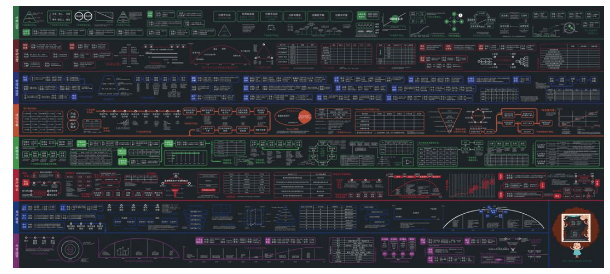
The skill set required for effective brand communications in the interactive marketing era is far more expansive than ever before.
What Does Good Interactive Marketing Actually Look Like?
As outlined above, running a campaign that achieves both strong engagement and strong reach in today’s environment demands a great deal from brands — in both strategy and execution.
But brands don’t have to figure this out alone. The right platform and methodology can multiply results significantly.
So what makes a platform capable of enabling truly effective interactive marketing? Brands should evaluate along several dimensions:
- The platform must have sufficient scale to sustain and amplify content distribution, minimizing audience loss when content travels across channels.
- The platform must have genuine interactivity built into its DNA. No single brand can manufacture user engagement on a platform that was never designed for it.
- The platform must offer product features and formats that can support the specific goals of a brand campaign — without the right tools, even the best creative idea cannot be fully realized.
Douyin’s (TikTok’s) Hashtag Challenge is perhaps the most archetypal product format built for interactive marketing. The Challenge mechanic originated from organic user behavior — and once commercialized, it layered brand investment on top of this native behavior, creating an organic fusion of user action and brand promotion. It gave brands a native tool through which users could actively tell the brand’s story on its behalf.
From a study of what makes interactive marketing work, the Douyin Hashtag Challenge offers a wealth of lessons.
The Hashtag Challenge was one of Douyin’s earliest campaign formats and contributed significantly to the platform’s explosive early growth. Today it stands as one of Douyin’s flagship assets and most powerful product offerings.
It is also a format with strong viral mechanics built in. Through simple, accessible design, it encourages users to participate, imitate, and riff on various challenge styles — transforming users into active distribution nodes with strong amplification and cascading effects. It is a textbook product of the content-social ecosystem’s virality mechanics.
The first key advantage is an extremely low barrier to participation. Douyin’s rise was itself part of a broader wave of lowering the production cost of video content, reducing the technical and creative threshold for short-form video creation at the product level. Native features like duets, split-screen, co-shooting, and stickers allow ordinary users to produce highly consumable content through the simplest of actions.
The Hashtag Challenge format goes even further, lowering the creative planning threshold for users — by following simple prompts or using engaging stickers, anyone can generate their own version of premium-looking content, with the planning and visual work already done for them at the product level.
From the brand’s perspective, Douyin’s existing Hashtag Challenge infrastructure — built on a foundation of high-engagement, high-quality organic cases accumulated before commercialization — also significantly lowers the planning and development costs for campaign activations.
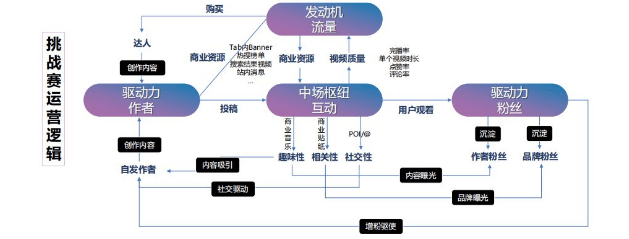
An overview of TikTok Hashtag Challenge operating logic, from the “2019 H1 Douyin Hashtag Challenge Value Research White Paper”
Beyond product mechanics, the Hashtag Challenge as a native content format on Douyin has achieved broad user recognition and familiarity. From a user mindset perspective, this also reduces the operational burden on brands — brands don’t need to write lengthy rules and explanations. Users intuitively understand how a challenge works, which reduces friction and streamlines campaign management.
Furthermore, since 2016, Douyin has built a mature, tested operational methodology for Hashtag Challenges — one that brands can access as part of the commercialized offering.
One example is the TIME model, a core part of Douyin’s Challenge operating framework. TIME stands for: Traffic Value, Interaction Value, Motivation for Creating, and Enrichment of Fans.
These four metrics enable brands to scientifically quantify the commercial value of a Hashtag Challenge, and to surface real-time optimization directions as a campaign unfolds. The 2019 H1 Douyin Hashtag Challenge White Paper noted, for instance, that while advertisers tended to favor drama-style and showcase-style stickers, their actual performance as measured by the TIME model diverged significantly. Showcase stickers, with their low participation barrier, scored consistently high overall. Drama stickers, while richer in product information, required multi-step comprehension from users and therefore generated comparatively modest engagement in practice.

The Wan Chai Pier #来人,赏红运当头 case on Douyin Hashtag Challenges.
In practice, the stickers that score highest on the TIME model are fortune-draw and personality-test formats — simple to participate in, inherently fun, and highly engaging among users. This illustrates a critical insight: intuitive assumptions from campaign operators need to be validated and corrected by quantitative user feedback data. Only then can teams build an accurate picture of real user engagement performance, iterate quickly, and avoid wasting premium resources.
From the Douyin Hashtag Challenge case, we can distill several principles that define effective interactive marketing:
- A platform with large traffic volume and high inherent interactivity
- Flexible and effective product formats
- A low barrier to user participation
- An optimization mindset grounded in real user engagement feedback
Only when all these elements are present can brands achieve truly effective two-way communication in the age of interactive marketing. The reason brands pursue high engagement is, at its core, to get users genuinely involved in the brand’s story. Participation is what drives real understanding — and what produces authentic viral effects. And it is through user-initiated sharing, not brand-driven distribution, that the most valuable impressions and conversions are generated.
Historically, one of the key tensions in high-engagement marketing was the tradeoff between low participation barriers and the quality of UGC. If the bar to entry is too low, the content users produce may not be worth consuming; if users can’t easily participate, their motivation to spread the content disappears.
Today, new product formats have given brands powerful new tools. Solutions like the Douyin Hashtag Challenge have already struck this balance: features like stickers and filters ensure the content is visually appealing, while time-tested interactive mechanics keep the participation threshold low enough that ordinary users can produce content that is both entertaining and brand-communicative. Layered on top with mature operational frameworks and measurement systems, interactive marketing now has built-in feedback loops for continuous self-improvement.
In the attention economy, fleeting exposure is no longer enough to achieve the genuine emotional resonance and conversion that brands need. Combining interaction with brand communication is what truly builds user awareness, draws people in, and activates a network of nodes to generate real, sustained brand presence.
*This article is adapted from the WeChat public account “深响” (Deep Echo), authored by Ma Xiaojun.