The Business Logic of the Digital Age: Connection-Driven Growth
Whether it's Mini Program transactions, online content marketing, or offline acquisition campaigns, all roads eventually lead back to the brand's own traffic pool — becoming lasting digital assets for the business.
Having a close friend who is a hardcore K-pop fan has its perks. Even though I never personally voted in any of the idol survival shows these past couple of years, I watched her every move — buying yogurt to scan QR codes, rallying on Doki, spending Weishi energy to earn fan-meet tickets. Somewhere along the way, I got a first-hand education in just how much pull a rising idol has over their fanbase.
Of everything I witnessed, what surprised me most was the mass yogurt-buying campaign.
When my friend looks back on those days spent with her fan group — scanning codes together, voting through the night — she sums it up in one sentence: “It was brutal. We had no choice but to keep voting.”
Apparently, during that stretch, her phone storage was monopolized by voting screen-recordings and QR code screenshots, while her refrigerator overflowed with yogurt she had to give away to family and friends.
I personally benefited from a free yogurt supply for a while. But it was only later that I began to appreciate the commercial mechanics behind that yogurt-scanning voting campaign, and what it revealed about the digitization of the retail ecosystem.
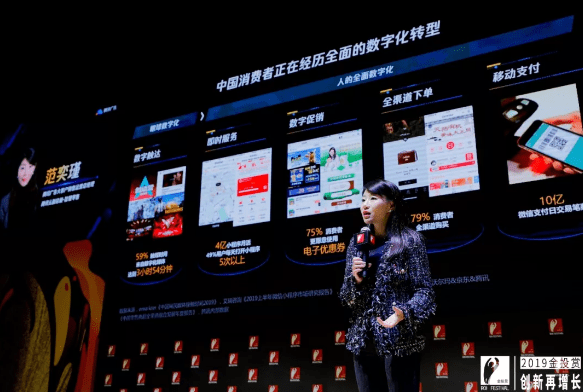
On October 16th, Fan Yijin — General Manager of Sales Operations for Tencent Advertising’s large clients and VP of Tencent Cloud Smart Retail — delivered a keynote at the Golden Investment Awards that year. She cited this nationwide voting campaign as a case study, and traced the growth engine powering it: content, social, channel, and data.
01. Growth and Digitization in the Physical Retail Sector
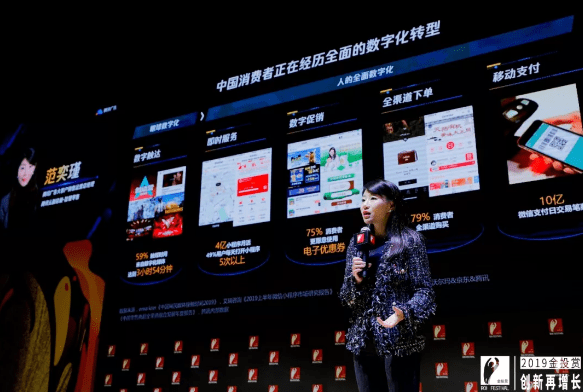
Addressing the physical retail industry, Fan Yijin’s keynote — titled “Digital Connectivity Driving New Brand Growth” — described a fundamental shift: the transition from an “attention economy” to “the digitization of people.”
Over the past year, the entire market has undergone a sweeping integration around digitization — encompassing the digitization of people, products, media, and channels alike.
This wave of digitization across every link of the value chain has, in turn, accelerated the digital transformation of physical retail.
But for brick-and-mortar businesses, embracing digital transformation isn’t just about competing with e-commerce, unlocking incremental revenue, or improving operational efficiency. There’s another significant benefit: consumer touchpoints become far more accessible.
Take Mengniu Dairy as an example. Before digitization, the vast majority of Mengniu’s channels ran through offline supermarkets and e-commerce platforms — making it nearly impossible for Mengniu to capture consumer-end data. This, of course, is a challenge shared by the entire physical retail industry.
In 2013, Mengniu introduced a “one product, one code” QR system via WeChat as a way to reach consumers directly, and simultaneously launched WeChat customer service. From there, Mengniu leveraged the WeChat ecosystem to execute a series of “Internet+” upgrades — including the Produce Camp 2019 yogurt-scanning vote campaign and the spin-the-wheel giveaway featuring Chunzhen yogurt on Chinese Restaurant.
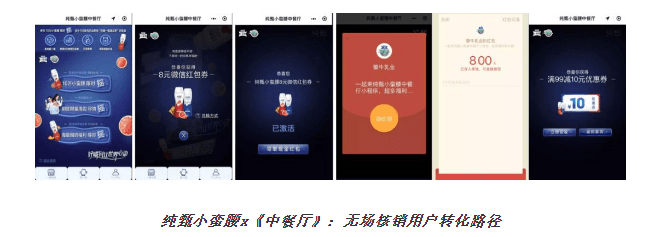
Chunzhen Slimwaist x Chinese Restaurant: Offline-to-Online User Conversion Path Without a Fixed Location
In Mengniu’s digitization journey, the starting point was product digitization — one product, one code. From there, they progressively connected every other layer of the value chain.
On the surface, the QR code is just an information carrier: scan it, trace the product’s origin, follow the official account. But in practice, the front end of that code connects to media digitization, while the back end connects to channel digitization. A single code threads together content marketing, Mini Programs, and the entire purchase funnel.
In traditional retail, consumers either buy online through an e-commerce platform or offline in a physical store — an either/or choice. The code breaks that dichotomy. Offline retail now has its own mini e-commerce storefront. And embedded within the scanning experience are built-in acquisition and growth mechanics: issue digital coupons, and consumers redeem them through the WeChat Mini Store in a fully digital channel.
Through that single code, Mengniu solved both its growth problem and its consumer reach problem simultaneously.
There is one prerequisite, of course: executing all of this requires a powerful middle-platform capable of unifying traffic management, marketing, coupon issuance, redemption, and payment in a single system.
Tencent Advertising is that middle platform. Today, within the Tencent ecosystem, a closed-loop integrating traffic, Mini Program hosting, digital coupons, and payments is fully operational. Inside this loop, the line between online and offline dissolves — and each reinforces the other.
02. The Four Engines of Connection
Growth is every brand’s primary concern. Yet for most, the question of how to achieve it remains largely unanswered.
Tencent Advertising offered a framework built around four growth engines.
Engine One: Content
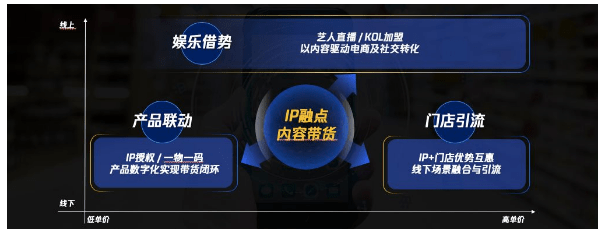
Content marketing has been a recurring theme this past year — but in practice, most executions have stayed surface-level: IP licensing, title sponsorships, brand associations. Tencent’s content engine represents a more integrated solution.
One area Tencent highlighted specifically was the digitization of physical stores.
Tencent’s data shows that after certain physical retailers underwent smart retail transformation, the percentage of visitors who actually entered stores climbed from 10% to 40%.
The concept of a “digital store” may still feel abstract to many. But most women have encountered one already: the “magic mirror” at a cosmetics counter. Stand in front of it, pick up a lipstick, and the mirror instantly renders that shade on your lips. Same with eyeshadow palettes — drag a color onto the screen and watch your look transform.
For female consumers, this kind of digital store is remarkably frictionless. Most women are already wearing a full face of makeup when they walk in. Digital try-on means no need to remove makeup, no need to test testers that dozens of people have already touched. Swipe through products on screen, select what you want, scan via Mini Program, skip the register queue, and walk out in minutes.
This is the most visible form of the smart store. Behind it lies an even more granular, data-rich operating model.
The content engine also encompasses product co-branding, entertainment tie-ins, and various crossover collaborations. For physical companies in food, beverage, and FMCG, the intersections of content and in-store traffic — and of content and product integration — offer rich territory to work with.
Tencent provides brands with a broad portfolio of hit IP properties, creative content platforms, and multi-channel content matrices to help them reach consumers both online and offline.
In short, it’s not just the store-content combination that drives offline traffic and fuels growth. Channel licensing deals and IP partnerships can all serve as vehicles for effective content marketing.
Engine Two: Social
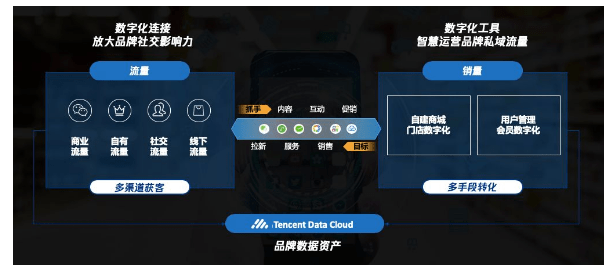
When brands run promotions, sign celebrity endorsers, or place advertisements, they are fundamentally building closer relationships with consumers. That is, in essence, social engagement.
But for most brands, social activity only makes consumers aware of you — it rarely compels them to actively seek you out. Social reach grows, but incremental value is left on the table.
Tencent’s answer is “connected growth” — moving brands from traffic to revenue.
This translates to a dual transformation: on the traffic side, integrating commercial traffic, owned traffic, and social traffic to drive multi-channel acquisition; on the operations side, converting that traffic into sales through owned storefronts, store digitization, and a range of conversion tactics.
One example: reactivating dormant fans via Official Account posts. Joyoung, the soy milk appliance brand, used a WeChat Official Account push to trigger Mini Program purchases directly — a clean, scenario-based conversion flow. Beauty brands have executed Mini Program livestreams with AI virtual try-on built in.
What differentiates Tencent’s approach from other platforms’ conversion playbooks is that it fundamentally helps brands build their own data assets. Whether it’s ad performance, user operations, or sales data — it all belongs to the brand. And that proprietary data feeds back into smarter, deeper consumer connections.
Engine Three: Channel
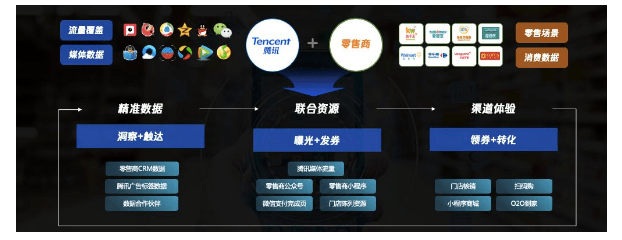
The channel engine is centered on unlocking the value of digitized commercial districts.
The purpose of a “district” is connection. A digitized commercial district links retailers across categories into a shared marketing field where resources and traffic flow freely between them.
Tencent Advertising has partnered with retailers across grocery and convenience, mother-and-baby, beauty, and department store verticals, building a three-party collaboration model with brands and distributors that extends the marketing boundary from market-facing to channel-facing.
Take a digital coupon: a consumer can redeem it in-store or through a Mini Program storefront. Either path works.
Tencent provides retailers with data capabilities and broad media reach, helping them integrate their offline strengths — ground-level promotion, discounting, procurement and merchandising — with online traffic. KOL and celebrity involvement can be layered in at any point to lift click-through and conversion rates.
Within this channel connection model, the value of the digitized commercial district becomes tangible: member and fan data from Mini Programs, offline digital signage, and in-store sales associate touchpoints all converge — ultimately enabling customer acquisition and audience activation across every channel.
Engine Four: Data
Tencent’s data engine gives brands the ongoing ability to turn insights into conversions.
Through the Tencent Data Cortex (TDC), brands can pool data assets from the brand itself, Tencent, and channel partners — supporting an end-to-end capability stack that spans creative insight, custom audience modeling, and cross-platform integrated ad delivery. The result: more precise targeting of high-potential customer segments, continuous refinement of interest-based audiences, and measurably improved conversion outcomes.
Together, the four engines — content, social, channel, and data — converge on a single vision: “Store as media. Experience as marketing. Connection as growth.”
03. Building a Brand’s Digital Social Assets
The digital inflection point for physical retail has arrived.
As smart retail continues to reshape offline commerce, the efficiency and experience of the existing market will keep improving — while the incremental market will continue incubating entirely new business models.
Looking back at the history of physical retail, from department stores to supermarkets to e-commerce to mobile shopping, the industry has moved through a clear arc: production as king, then channel as king, and finally the consumer at the center.
Serving personalized shopping needs has become the defining challenge of this third era — and the defining expectation of the younger generation. Companies like Tencent are using technology to translate those individualized needs back to brands, enabling them to meet the rapidly evolving preferences of a new generation of shoppers.
In the e-commerce era, people were reduced to a single ID. You knew someone had bought something, but you knew very little about who they actually were or what they genuinely needed. In the smart retail era, however, a consumer’s real-world identity and their digital network ID are linked — this is what “the digitization of people” truly means.
This richer, more dimensional consumer profile means brands must actively embrace digitization in return.
In response to this trend, Tencent has introduced an advisory management model for brands. The model is designed to connect the company, WeChat, sales associates, and consumers in a single ecosystem. Consumers gain safer, more curated access to Mini Program recommendations, better product information, and more targeted content. Sales associates benefit from Mini Program watermarking: when a consumer places an order through a specific associate’s link, that sale is attributed directly to them. For the brand, the model maximizes the productivity of the sales associate network, generating revenue well beyond what public traffic alone could deliver.
In this advisory management model, sales associates cultivate deep trust relationships — helping the brand accumulate “social capital” that translates into organic word-of-mouth and credibility with a wider pool of potential buyers.
The bottom line: whether it’s Mini Program transactions, online content marketing, or offline acquisition campaigns, all roads eventually lead back to the brand’s own traffic pool — becoming lasting digital assets for the business.
Retailers who have gone through digital transformation are no longer advertising on traffic platforms and media platforms. They are the traffic. They are the media. Because every Official Account and every Mini Program is accumulating digital social capital — compounding value that belongs entirely to the brand.
*This article is adapted from the WeChat public account “Wu Duidui,” authored by Wu Duidui.