How Should a CMO Drive Digital Marketing Transformation?
Essential reading for every marketer navigating digital transformation.
As a CMO who has spent nearly a decade at the same company, I ask myself this question every single day: “How do I drive digital marketing transformation — and use it to fuel real business growth?” Every time I raise it, I hear the same kinds of responses. “Marketing transformation is a CEO-level concern — don’t worry yourself with it.” “It’s a systems initiative that requires company-wide coordination; the marketing department can’t push it alone.” “Digital transformation demands enormous long-term investment with low short-term ROI — you don’t want to own that.” “You’re a manufacturer of industrial automotive lighting. You have no big data and no IT capability. How are you going to go digital?”
Despite all that resistance, I refused to give up — because I have always believed that a CMO who knows how to read the moment, embrace change, and create genuine value for customers is a CMO worth having.

So last year, my team and I launched a small but meaningful experiment: using SCRM to build a compact O2O business loop. Automotive lighting is a low-frequency, low-interest product category, and car owners rely heavily on offline repair shops for installation and service. Over recent years, however, the rise of mobile internet has meant that more and more car owners turn to the web and social media when researching automotive parts.
The question became: how do we use online platforms and technology to empower offline shops?
We had already established a WeChat Service Account called “OSRAM Automotive Lighting” back in 2014, targeting end consumers (ToC). After four years of dedicated management, we had grown that account to over 82,000 followers.
Recognizing that our B2B and B2C audiences had entirely different needs, we also created an Enterprise Account — “Retrofit Club” — specifically for lighting modification shops. This brought over 1,200 of our core retrofit shops onto a single platform.
As we managed both accounts, we noticed a recurring pattern: after reading our product showcases and case studies, fans would frequently comment asking where to buy, what the price was, and how to get installation service. Typically, our content editors would spend two to three days tracking down store contact numbers from the sales team before passing them along to fans — who then had to reach out to shops on their own.
Meanwhile, during my visits to modification shops across the country, most owners told me the same story: because repeat purchase rates were low, they were constantly chasing new customers — running WeChat Moments ads or paid search campaigns that drained both budget and energy.
That’s when it clicked: why not bridge these two ecosystems — 80,000-plus end consumers on one platform and 1,200 shops on the other? That’s when we started seriously exploring MarTech and SCRM.
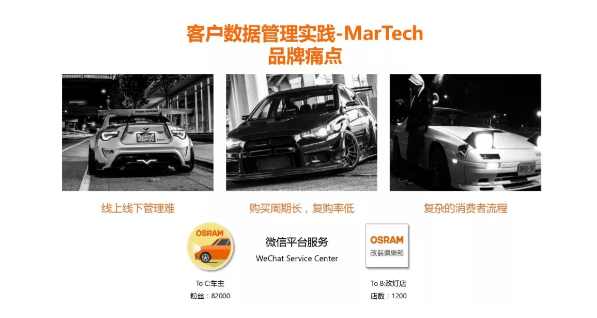
Deploying an SCRM framework allowed us to connect siloed data, activate unmet demand, build precise customer profiles to accelerate conversions, drive more traffic from end consumers to shops, and strengthen each shop’s ability to acquire and convert customers.
So how exactly did this SCRM system operate across both platforms?
(1) Inbound marketing to grow the consumer account. We mapped the purchase journey of our target car owners and ran multi-touch, multi-channel inbound campaigns — PR, search engine marketing, online activations, and offline experience events — to steadily pull prospective buyers into our WeChat Service Account.
(2) Targeted outreach to expand the retailer network. The Enterprise Account’s existing shop coverage had geographic gaps, so we ran targeted B2B campaigns directed at 3,000 key modification shops nationwide, tailoring promotional and referral incentive programs by customer segment.
(3) Activating consumer demand and routing it to shops. We ran WeChat H5 surveys to build rich audience profiles of our Service Account followers. Then, using viral sharing campaigns tied to shop promotions, alongside compelling installation case studies, easy vehicle compatibility lookup tools, and anti-counterfeit verification services, we continuously activated follower demand — and channeled those intent signals directly to the retrofit shops on the Enterprise Account.
(4) Empowering shops to convert more effectively. We segmented modification shops using order and behavioral data, then rolled out tiered support: a points-based rewards system, a brand-image upgrade program, and dedicated sales coaching — all designed to lift conversion performance across shops at every tier.
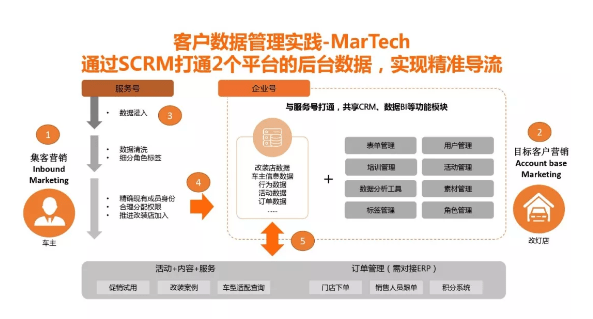
The result was a clean, elegant O2O loop: online traffic generation → online order intake → offline installation. MarTech enabled precise, automated, real-time data flows between the two platforms, eliminating friction at every handoff.
After more than a year of running this MarTech-powered SCRM system, OSRAM Automotive Lighting’s fan engagement rate grew by 110%. Average interaction rate (likes, shares, and comments relative to reach) reached 7.9%. Sales conversion among engaged followers improved threefold, and revenue from a single LED retrofit product line doubled.
The results of this small but deliberate MarTech pilot left me genuinely encouraged. Digital marketing transformation isn’t nearly as daunting as it sounds. It doesn’t require a top-down mandate, a company-wide mobilization, or a massive system investment. Transformation can start small — and still deliver.

I drew significant inspiration from Robert Rodriguez, the Hollywood director whose debut feature El Mariachi was made for just $7,000 — less than 50,000 RMB. In Hollywood, making a film without serious money and resources is essentially unthinkable. Yet the young Rodriguez found ways around every constraint: he reportedly enrolled in drug trials to fund production, and took on the roles of writer, director, cinematographer, producer, and special effects artist himself. The result? A $7,000 film that sold for $500,000 and ultimately earned $2 million at the box office.
At the outset of our own digital marketing transformation, we took the same approach: maximize the resources you already have, don’t be afraid to start small, and always stay focused on moving the growth needle. What this experiment also reinforced for me was this: as a CMO, don’t transform for transformation’s sake. Don’t turn digital marketing into a flashy, top-line initiative designed to impress the CEO. Instead, root yourself in the business — understand your commercial model, understand your customers’ pain points, and develop a deep grasp of how data and technology actually drive revenue at the operational level.
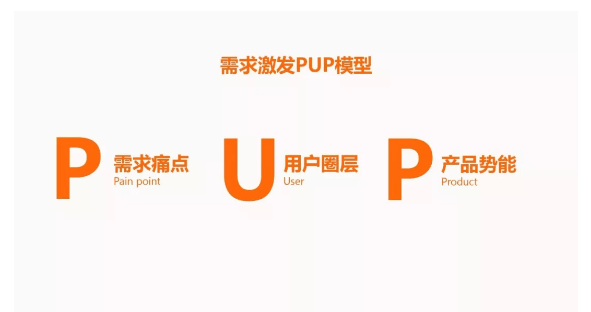
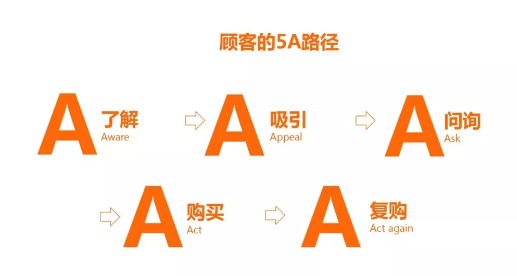
I want to share two frameworks that proved especially useful throughout this initiative. The first is the PUP model for demand activation from The Three Algorithms of Marketing. The second is Philip Kotler’s 5A Customer Path, which he recently outlined in his Marketing Futures keynote.
The PUP Demand Activation Model:
-
P — Pain Points: Going back to the original insight behind this initiative, we identified two sets of customer pain points. On the retailer side (B), shops lacked brand backing, which undermined sales confidence, made customer acquisition difficult, and depressed conversion rates. On the consumer side (C), car owners were hesitant — worried about product authenticity, and concerned that a lighting modification might damage their vehicle. Those pain points became the seed of our idea: build a virtuous business ecosystem that resolves both sets of concerns simultaneously.
-
U — User Segmentation: On the B side, we deliberately focused on modification shops as a single, specialized channel — not the broader universe of repair garages and 4S dealerships. And within that segment, we selected 1,200 shops from a pool of 3,000 based on their willingness to collaborate and their service capability. On the C side, our audience survey revealed a clear core profile: male car enthusiasts aged 25–35, rational and detail-oriented in their purchase decisions.
-
P — Product Momentum: Everything had to connect back to product and revenue. We selected a high-price, high-margin LED product as our pilot. This gave shops a compelling commercial incentive while giving consumers a triple assurance of quality, performance, and service — conditions that together maximized value transfer through the loop.
The 5A Customer Path:
Throughout this transformation, we kept the end consumer’s journey as our north star. In the past, getting our LED products in front of actual car owners had been a persistent challenge for us as a brand. Our reach typically stopped at the first two A’s — Aware and Appeal — through brand activations, PR, and search. The remaining three A’s (Ask, Act, Advocate) were consistently disconnected.
This time, by empowering modification shops to own the Ask–Act–Advocate experience, and by using SCRM to create seamless handoffs at every touchpoint, we were able to close the full loop. Customer data from both ends gradually accumulated within our WeChat ecosystem — what the industry now calls a “private traffic pool” — where it could be continuously nurtured and converted.
The bottom line: the key to successful digital marketing transformation is “data monetization powered by technology.” Data is the lifeblood of the enterprise. The real work is learning to activate dormant data — setting it in motion so it creates value.
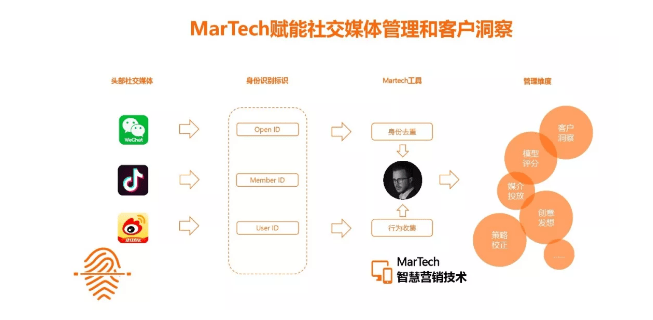
Beyond that, we need to identify the most effective tools for that activation. In our case, MarTech was the right choice because it delivered two distinct functions in service of our revenue goals:
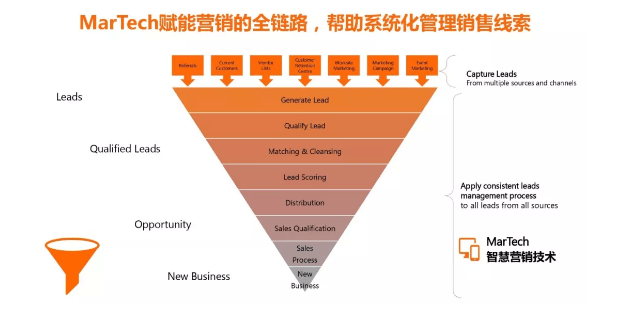
Function One: MarTech as Filter
From lead generation through lead management to final conversion, MarTech dramatically improves the efficiency of the entire pipeline — particularly once you’re managing more than a thousand leads simultaneously. Its systematic, intelligent data processing surfaces your highest-quality prospects, which directly lifts conversion rates.
Function Two: MarTech as Scanner
MarTech gives marketers the customer insight they need to execute precision marketing and sharpen the effectiveness of every campaign. On the WeChat platform — the most accessible channel for most B2B companies — as your follower base grows, you need MarTech to authenticate identities and capture behavioral signals. This tells you who your followers actually are, where they’re located, and what products and services they’re genuinely interested in. With that foundation, you can design better content and better campaigns — content that converts and performance that compounds over time.
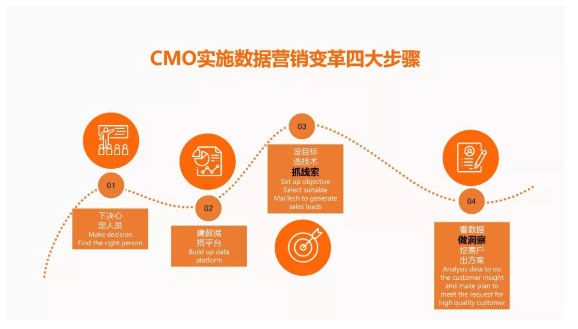
Finally, here are the four critical steps for driving digital marketing transformation:
Step 1: Commit to it — and staff for it. Whether data and technology can deliver real commercial results depends entirely on the people who wield them. As marketing becomes increasingly operationally driven, you need someone on the marketing team who combines data literacy, business acumen, and customer empathy. This person needs to be always-on — continuously monitoring and mining data to surface shifts in customer behavior and demand.
Step 2: Build your data layer and establish your platform. Design customer touchpoints along the 5A journey and embed your data collection mechanisms at each one. Then aggregate everything into a centralized platform — your “private traffic pool.” This can be as lean as an SCRM built on WeChat or as comprehensive as a full CDP. The form matters less than the function: get your customer data accumulating and working for you.
Step 3: Set goals, select technology, and go after leads. Anchor your digital marketing objectives to your sales targets. Define specific goals — lead generation volume, conversion rate improvement — and then choose the technology best suited to achieve them. Let the technology do what it’s built for: surface leads and drive revenue.
Step 4: Read the data, generate insight, build the plan. Instill a data-first mindset across the team. Make it a habit to check the numbers before making any decision or developing any strategy. Over time, your marketing plans become progressively more grounded, more aligned with what customers actually need, and more effective at creating real value for them.
We live in a VUCA world. The only constant is change. But as CMOs navigating the long road of marketing transformation, there is one thing that should never change: our conviction. Hold fast to the mission of marketing. Hold fast to the belief that our job is to create genuine value for customers. In the face of complexity, uncertainty, and relentless headwinds, keep climbing. Be the marketer who never quits.
*This article was originally published on the WeChat public account “Market Department Network” (市场部网), authored by Lucy.