L'Oréal's China Playbook: The Power Behind KOLs Like Li Jiaqi
Most people know Li Jiaqi — China's "Lipstick King" — but fewer realize the force behind his rise is L'Oréal, the world's largest cosmetics company.
Most people know Li Jiaqi — China’s “Lipstick King” — but fewer realize the force behind his rise is L’Oréal, the world’s largest cosmetics company.
In October 2016, L’Oréal launched a groundbreaking initiative in China: transforming its in-store beauty advisors (BAs) into social media KOLs. The company called this program “BA Influencerization.” By 2017, L’Oréal had partnered with Tmall Global and beauty agency MEI ONE to select and train 200 counter BAs as Taobao livestreamers. Li Jiaqi was one of them.
The results were impressive.
On one front, the “BA Influencerization” program aligned perfectly with Alibaba’s content-driven commerce strategy, deepening the partnership between the two companies. On another, L’Oréal successfully drove sales through its KOL network. Data shows that in just the first half of 2018, Li Jiaqi livestreamed 80 sessions for L’Oréal, generating over ten million RMB in direct sales. In doing so, L’Oréal effectively pioneered KOL-driven marketing in China’s beauty industry.
There is a French proverb: “Fish where the fish are.” For L’Oréal, China is undoubtedly a prime fishing ground.
L’Oréal’s Chairman and CEO Jean-Paul Agon has noted that e-commerce now accounts for nearly 40% of the company’s China revenue — a figure that stood at just 27% two years prior.
“In 2018, China’s cosmetics market grew at three times the pace of the U.S. market,” said Fabrice Megarbane, the newly appointed President of L’Oréal China. He projected sustained strong growth in China over the next five years. He also noted a key structural difference: while color cosmetics and fragrances dominate in Western markets, skincare holds the lion’s share in China — leaving substantial room for L’Oréal to grow in makeup and fragrance categories.
Yet sustaining and growing market share in China requires playing by China’s rules, while navigating intensifying competition from multiple fronts.
Competition from a Familiar Rival: P&G
The first challenge comes from longtime rival Procter & Gamble.
After years of declining performance, P&G embarked on a difficult but ultimately successful transformation — one clearly reflected in its latest earnings results. China has been central to that turnaround.
In 2015, P&G launched a streamlining plan, trimming its brand portfolio from 170 to 65. It simultaneously pushed into premium products and diversified its marketing approach to win back Chinese market share. The two companies mirror each other in many ways: L’Oréal has L’Oréal Paris and Lancôme; P&G counters with Olay and SK-II. L’Oréal signed TFBoys as brand ambassadors; P&G recruited traffic-driving celebrities like Wang Yibo and Xiao Zhan. Both have embraced KOL marketing, seeding products on Xiaohongshu and Weibo and opening official brand stores. As Tencent’s Prism reported, L’Oréal and P&G have joined the street-level battle of China’s new retail war.
The Rise of Chinese Domestic Brands
The second competitive pressure comes from the rapid ascent of homegrown brands.
In May 2017, Pechoin’s cinematic long-form advertisement 1913 — styled after the Republican era — went viral on WeChat Moments. That same year on Double 11, domestic brands like Pechoin and Chando outperformed international heavyweights including Estée Lauder, SK-II, and Lancôme.
By October 2019, Perfect Diary had surpassed 10 million followers on Taobao — reaching the same scale as L’Oréal — but it accomplished this in just 26 months from zero.
Internal Adjustments on L’Oréal’s Agenda
Beyond external competition, L’Oréal must also manage its own portfolio complexity. Over the past two years, the company has accelerated brand acquisitions in both China and globally — most notably MG (My Gelastin) and the recently completed acquisition of Clarins fragrances. While L’Oréal’s data shows MG achieved “double-digit growth” in 2018, the brand’s overall performance remains a work in progress. How to “reclaim market position” for MG is a strategic question both the brand and L’Oréal must address. Additionally, tightening Chinese regulatory oversight of “cosmeceuticals” requires brands like La Roche-Posay to revisit both product positioning and go-to-market strategy.
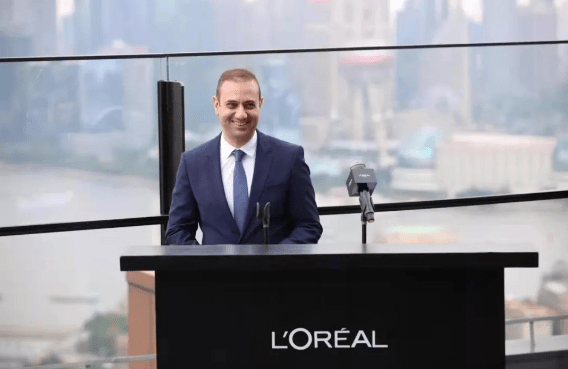
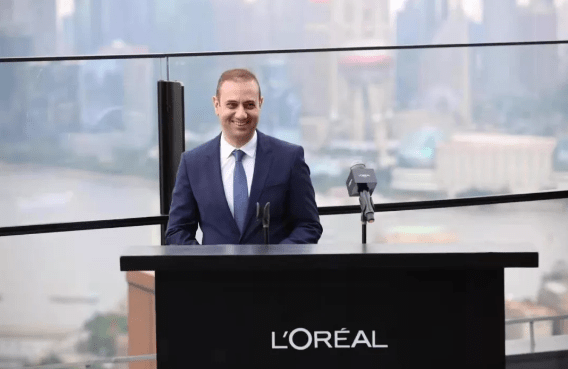
At the 2nd China International Import Expo, Fabrice Megarbane sat down with China Entrepreneur magazine to discuss L’Oréal’s China strategy and the broader trends reshaping the beauty industry. “The beauty industry today looks nothing like it did twenty years ago,” he said.
The following is an edited excerpt from that interview:
China as a Hub for Innovation
CE: L’Oréal has stated that China will become the world’s largest beauty market. What new trends or changes are you seeing in China’s cosmetics industry?
Megarbane: China’s influence on the world has never been as broad or as deep as it is today, and the world’s attention on China has never been more intense. China is now L’Oréal’s second-largest market globally, and for us it has become a hub for group-wide innovation.
In 2018, China’s overall cosmetics market grew at three times the rate of the U.S. market, and the country has maintained strong growth momentum for the past five years. Unlike markets in Europe and the U.S., where color cosmetics and fragrances account for the largest share, skincare dominates in China — which means we still have tremendous potential in color and fragrance.
From L’Oréal’s perspective, China’s beauty industry has transformed dramatically compared to twenty years ago:
- Premiumization meets personalization. Consumers are not only seeking higher-quality, higher-value products and services — they’re demanding variety and customization to meet individual needs.
- Tier and age segmentation are fading. The rapid growth of the internet and e-commerce means virtually anyone, anywhere in China, can access any product through multiple channels.
- The wall between offline and online is coming down. This creates enormous convenience for consumers. Offline pop-up stores drive traffic to online flagships and vice versa, while purchase data helps brands better understand their customers.
- China as a global launch platform. More and more brands are choosing China as their first market for new product launches — with insights flowing back to the rest of the world.
CE: Compared to other markets, what do you see as China’s defining characteristic? And where is the biggest challenge for L’Oréal?
Megarbane: The opportunity belongs to China’s young consumers — and that makes it uniquely special. That is precisely why L’Oréal must get closer to young Chinese consumers. China’s younger generation not only spends at impressive scale, but they also have a stronger appetite for premium products than their counterparts in other markets. This is not something you necessarily see elsewhere.
CE: How has L’Oréal repositioned and upgraded its flagship brand, L’Oréal Paris, over the past two years?
Megarbane: Consumer needs, the China market, and the overall competitive landscape are all shifting. Every brand needs to transform to succeed — not just L’Oréal Paris. Today, L’Oréal Group’s top 8 brands are all growing above the group average. Our goal is to make these 8 brands more relevant to young consumers. More importantly, we need to fundamentally change how we engage with them. The pre-sale model during Double 11 is a clear example of what that engagement looks like in practice.
CE: L’Oréal has been accelerating new brand introductions into China. What kind of brand portfolio is L’Oréal looking to build in the Chinese market?
Megarbane: When we bring new brands to China, it is never just for the sake of launching. We start by studying consumers — identifying which needs are not currently being met by our existing portfolio — and then decide what to bring in. Many Chinese consumers love Korean beauty trends, which is why we acquired the affordable K-beauty brand 3CE STYLENANDA. We believe it resonates with a broader consumer base. And after acquiring 3CE, we have seen no cannibalization of our other brands. Every brand in our portfolio has its own distinct positioning. Our goal is to participate in every meaningful market segment and serve every type of consumer.
CE: Product homogenization remains a persistent challenge across the beauty and skincare industry. With everyone racing to expand in China, how does L’Oréal build a sustainable competitive moat?
Megarbane: Beauty technology is transforming not just products, but the entire consumer journey — which makes quality more important than ever. Quality has always been L’Oréal’s foundation and our natural competitive advantage. We fundamentally believe that Chinese consumers are discerning: they can tell what is good. Beyond that, every L’Oréal product must have a distinct market positioning. Personally, I do not believe the industry has reached the point of true homogenization. If it ever did, that would signal the end of the industry altogether.
Partnering with Alibaba in China
CE: How is L’Oréal’s strategic partnership with Alibaba progressing? How has Alibaba supported L’Oréal’s digital transformation, and what does the company’s online sales mix look like in China today?
Megarbane: Chinese consumers’ adoption of and comfort with digital tools far exceeds that of any other market in the world, and China’s digital and e-commerce ecosystem continues to flourish. E-commerce now represents close to 40% of L’Oréal’s China business, and Alibaba is a long-standing, highly valued strategic partner. Together we have co-created a range of innovations — the most notable being La Roche-Posay’s “Effaclar AI Acne Detection Application.” Consumers visiting La Roche-Posay’s Tmall flagship store can assess their skin health online; when issues are detected, the system automatically recommends appropriate products. This was first pioneered by L’Oréal in China and has since been rolled out to consumers worldwide.
CE: L’Oréal recently announced a completed investment in Cathay Innovation — its first investment in a Chinese VC fund. Where will L’Oréal focus its future investment and strategic development efforts?
Megarbane: This investment will help L’Oréal embed itself more deeply within the beauty tech startup ecosystem — particularly China’s innovation ecosystem. We believe that China’s beauty tech companies are reshaping the global beauty industry. L’Oréal wants to provide more beauty tech startups with deep expertise, help them test and refine their innovations, and accelerate their development.
CE: The latest quarterly results show that L’Oréal’s Luxe division now contributes 38% of group revenue. Was that in line with expectations? Will L’Oréal continue to shift its mix toward luxury?
Megarbane: The premiumization of beauty is an inevitable trend. For L’Oréal, premiumization means delivering the most beautiful, most elevated beauty experiences to consumers — and consumers are increasingly willing to pay a premium for quality. They expect the best products and the best experiences.
Since 2017, China’s cosmetics market has re-entered an era of double-digit growth. The latest data puts the total market at 356 billion RMB, driven primarily by luxury beauty, e-commerce, and the explosive growth of color cosmetics.
I remain highly confident in the market, and we have no intention of slowing our investment in premium beauty. As consumer needs continue to evolve and grow more sophisticated, a one-size-fits-all product can no longer satisfy demand. L’Oréal will continue to deepen its investment in personalized product experiences to meet those individual needs.
Source: WeChat Official Account — China Entrepreneur Magazine. Authors: Xie Yunzi, Xu Shuo. Editor: Ma Jiying.