Let's Talk About New Retail: What It Really Means and Why It Matters
"New Retail" has become one of the hottest buzzwords in recent years — but what does it actually mean?
“New Retail” has become one of the hottest buzzwords in recent years.
But what does it actually mean?
Is an unmanned convenience store “New Retail”? Is Hema Fresh Market? Is Tmall’s neighborhood store format? Is JD.com’s “Boundaryless Retail” concept? What’s the defining standard?
Let’s go back to first principles.
To understand New Retail, we first need to understand what “retail” itself really is.
— 1 —
What Is Retail?
You open a clothing boutique on a commercial street — that’s retail. You run a small supermarket at the entrance of a residential complex — also retail. Even the elderly street vendor sharpening knives and calling out to passersby is doing retail.
Put simply, retail is about how we create a connection between products and customers — how we get products to buyers, or conversely, how we help buyers find the right products.
Suning sells you a Haier refrigerator; alternatively, you could say Suning helped you — a customer looking for a new fridge — find the right Haier model.
In Alibaba’s framework, retail is about connecting “goods” and “people” through something called a “place” (场, chǎng).
This “place” could be a physical location, a specific scenario, a call center, or even a face-to-face cold visit.
Anything that connects people and products can be considered retail.
With that framework in mind, let’s drill deeper into the three dimensions of retail — Place, People, and Goods — to understand what “New” Retail truly means.
— 2 —
New Retail Through the Lens of “Place”
If retail is about connecting goods and people through a “place,” then how exactly does that connection happen?
I believe three flows drive the connection between customers and products: information flow, capital flow, and logistics flow.

Let’s make these concrete with a simple example: buying clothes at a shopping mall.
You browse a jacket — checking the fabric, the price tag, comparing sizes, maybe trying it on. All of that is information flow: you’re gathering data to make a purchase decision.
You swipe your card at checkout. That’s capital flow.
The store associate bags the item and hands it to you. That’s logistics flow.
Every retail transaction, no matter how complex, ultimately comes down to these three flows: information, capital, and logistics.
For thousands of years, these three flows were inseparable — one seamless experience. But the internet changed everything. The emergence of digital channels is precisely why “New Retail” exists: new foundational elements entered the retail equation and transformed how retail operates.
— —
Let’s start with information flow.
Alibaba once ran a “Women’s Day Scan-to-Buy” campaign. Shoppers in a Walmart or Carrefour could scan a product’s barcode using the Tmall Supermarket app and discover that the same item cost ¥1.6 online versus ¥1.8 in the physical store. One scan added it directly to their Tmall cart.
Why is Tmall cheaper? Because online and offline have fundamentally different cost structures.
On that campaign day, many shoppers browsed Walmart or Carrefour aisles but placed their orders on Tmall.
Understandably, the brick-and-mortar retailers were furious: “You’re using our stores as showrooms but buying online?”
And that frustration is entirely valid — because in traditional retail, information flow, capital flow, and logistics flow were always bundled together. Retailers invested in store space, staff, electricity, and displays specifically because those costs were recouped through in-store purchases. The in-store experience was the funnel that captured all three flows at once.
But today, information flow and capital flow have been decoupled. Customers browse offline to gather information, then transact and receive delivery online.
This is the fundamental blow to the traditional supermarket business model.
During Singles’ Day 2019, Tmall recorded ¥268.4 billion in sales — roughly equivalent to the annual GDP of Cameroon or Latvia. That staggering volume was built on the back of supremely efficient information matching.
Yet even e-commerce has its limits. Try buying a mattress online. You can read all the specs and reviews, but you can’t actually lie on it and feel how it supports your body. That sensory experience simply cannot be replicated on a screen.
The internet accelerated information delivery but stripped away immediate, tactile product experience.
That’s why New Retail emerged.
I once interviewed Lei Jun (founder of Xiaomi), who shared an illuminating observation: Redmi phones outsell Xiaomi phones online, because when customers compare specs on a screen, the value proposition of Redmi wins. But in physical Xiaomi stores, the flagship Xiaomi handsets outsell Redmi — because when customers actually hold the devices, the premium feel of Xiaomi becomes tangible.
Embracing New Retail means merging the efficiency of online with the experiential richness of offline — giving consumers both speed and sensory engagement.
— —
Capital flow online has one defining characteristic: convenience.
Payment today is frictionless. We can tap our phones to pay for a street-corner roasted sweet potato. Vending machines that once required exact change now accept QR-code payments.
That said, online capital flow tends to dominate small-ticket purchases. Most consumers remain reluctant to complete large transactions online because digital trust and credit systems are still maturing. For high-value or big-ticket purchases, offline transactions still reign. This means major purchases and large-sum deals are better suited to offline environments.
— —
In traditional retail, logistics was never even a design consideration. Customers moved to find goods — people went to products.
E-commerce inverted this. Now goods move to find people — products come to customers, delivered anywhere, driving prices toward global equilibrium.
E-commerce’s logistics superpower is reach — you can order virtually anything from anywhere in the world. But its critical weakness is immediacy — and that’s where offline retail still dominates.
Immediacy matters differently depending on context. If you’re ordering a jacket, waiting three days is rarely a dealbreaker. But if you’re mid-recipe and realize you’ve run out of salt, you need it now — and a convenience store one kilometer away is your answer.
This explains a striking paradox: traditional supermarkets are struggling, while neighborhood convenience stores are booming. The reason? Convenience stores deliver immediacy.
When goods come to people, immediacy is always sacrificed.
After years of explosive growth, e-commerce growth in China began slowing. In 2015, total e-commerce sales represented only about 10% of China’s total consumer retail spend, with select categories reaching roughly 20%. Even as many predicted e-commerce would dominate everything, 80–90% of retail transactions still happened offline.
Why?
Because offline retail defends three critical attributes: experiential richness, trustworthiness, and immediacy.
New Retail’s mission is to find every possible way to fuse online efficiency and convenience with offline immediacy, experience, and trust.
So what, ultimately, is New Retail?
New Retail is higher-efficiency retail. It is the relentless pursuit of greater efficiency in information flow, capital flow, and logistics flow.
Every time you reduce the distance between a customer and a product by even an inch, you are doing New Retail.
— 3 —
New Retail Through the Lens of “People”
From the “people” perspective, “new” is always a relative concept. Every era has its own version of New Retail.
- In the era of neighborhood convenience shops, big supermarkets were “New Retail.”
- In the age of the internet, supermarket operators viewed e-commerce as “New Retail.”
- From e-commerce’s vantage point, the integration of online and offline — achieving higher efficiency across all three flows — is what defines New Retail.
Now let’s reframe through a consumer-centric lens. In e-commerce terms, retail performance can be broken down into a simple formula:
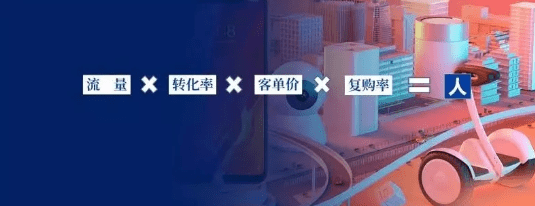
Let me walk through the four variables with a grounding example.
Imagine you run a clothing store. The number of people who walk past your storefront is your traffic (or “footfall” in brick-and-mortar language). You naturally want to locate in a high-traffic area, but high traffic means high rent — that’s your traffic acquisition cost.
Of every 100 people who pass your store, if 30 make a purchase, that’s your conversion rate (or “close rate” offline). Traditional retailers improved conversion through thoughtful product displays, store design, clear signage, and promotional discounts.
When a satisfied customer returns to buy again a few days later, that’s your repeat purchase rate.
And average order value is what happens when a customer comes in for one item and leaves with several.
From the “people” perspective, retail is fundamentally about these four metrics: traffic, conversion rate, average order value, and repeat purchase rate.
The fundamentals never change. New Retail is about systematically improving each of these four variables.
— —
1. Boosting Traffic
Here’s a personal example. I enrolled my son in an online English tutoring program. After careful evaluation, I was genuinely impressed — so I posted a photo of one of his lessons to my WeChat Moments. Given my network, the post generated significant interest, with many friends privately messaging to ask about the program.
I referred them all.
Some time later, a friend told me the program offered 10 free lessons for every successful referral.
When the year ended, I posted again — this time motivated not just by genuine appreciation, but by the incentive of 10 free lessons. My first share was advocacy-driven; my second was incentive-driven.
Regardless of the motivation, every share I made exposed the program to my network, generating free traffic.
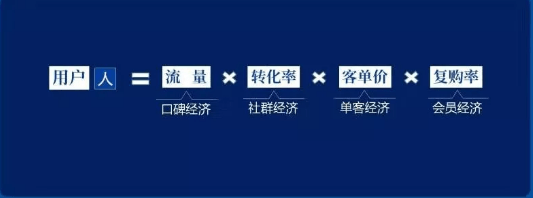
This is one of the most powerful levers for traffic growth, and the mechanism behind it is the word-of-mouth economy.
2. Improving Conversion Rate
Take my own course on the Dedao platform (a knowledge subscription app) as an example. My “5-Minute Business School” series has accumulated over 390,000 subscribers across two seasons.
How? Because Luoji Siwei (the parent platform) spent years cultivating a community of over 30 million users — users who share a defining characteristic: a hunger to learn and grow.
Because my product is a knowledge product, it’s a near-perfect fit for this audience. Conversion rate is high because the audience and the offering are precisely matched.
The mechanism here is the community economy.
The community economy’s core contribution to New Retail is precision matching between audience and product. Communities aggregate people around shared characteristics before the product ever appears. Deliver the right product to the right community and conversion naturally follows.
3. Increasing Average Order Value
This is where big data comes in.
I once bought an electric tool on Taobao. Days later, when I reopened the app, Taobao served me a curated feed of complementary accessories and related products. Several of those recommendations ended up in my cart — each one incrementally raising the value of my transaction.
Personalized, data-driven recommendation is the most scalable lever for lifting average order value.
4. Driving Repeat Purchase Rate
When I bought fruit at a street vendor near my apartment complex, the vendor offered me ¥5 off if I scanned his QR code. I did.
At 6 PM that evening, he sent me a message: “We still have fresh mangosteens left over today — if you’re out for an evening walk, swing by before 7 PM and get them for 30% off.”
I was out for a walk anyway. I bought the mangosteens.
At 10 PM, another message: “Fresh lychees coming in from Shenzhen tomorrow morning — incredibly sweet, 70% off for you.”
The next morning, I went back for lychees.
That’s repeat purchasing in action. The fruit vendor’s technique? I call it the membership economy.
In summary, New Retail — viewed through the “people” lens — means using the word-of-mouth economy to grow traffic, the community economy to lift conversion, big data to raise average order value, and the membership economy to drive repeat purchases.
— 4 —
New Retail Through the Lens of “Goods”
I’ve been thinking about a core question: once a consumer’s need arises, how do we get the right product into their hands as fast as possible?
To understand the “goods” dimension properly, it helps to trace the complete journey a product takes from creation to consumption. That journey has six stages:
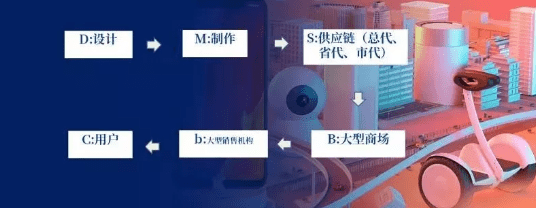
This is the complete supply chain — what I call the “acquisition logic.” Let me walk through each stage with real-world examples.
1. Design
Why is Zara so successful in retail?
Because it optimized the design stage. From concept to shelf, Zara’s cycle is just 12 days. That speed is Zara’s true competitive moat. If you can compress the time between design and sale, you are running a higher-efficiency retail operation.
2. Manufacturing
Costco, headquartered near Seattle, is the world’s most famous membership warehouse chain. Its annual net profit exceeds $2 billion — but nearly all of that profit comes from membership fees, not product margins. Costco’s blended gross merchandise margin sits around 6%, and no single product is allowed to carry more than 14% margin.
Why would Costco deliberately suppress product margins?
Simple: low prices make the membership fee worth paying. Once a member has paid, they keep shopping at Costco to justify the investment — and they renew the following year. Costco’s global renewal rate is 88%; in the U.S., it’s 90%.
The Costco-member relationship is a reframing of retail itself: by paying your membership fee, you are essentially hiring Costco as your personal global buyer — finding the best products at the lowest prices. The buyer earns a service fee, not a margin. It flips the incentive structure entirely.
3. Supply Chain
Germany’s Aldi is one of the world’s most efficient grocery retailers — and it will soon expand into China. Aldi’s prices in Germany are even lower than Costco’s in the U.S.
How?
Aldi radically narrows its SKU count, locates stores where population density is highest, and relentlessly eliminates every inefficiency in the supply chain. The result: an operation of extraordinary supply-chain efficiency.
4. Large-Format Retail
Miniso has built its product line by pushing efficiency to the extreme at every individual product level. With over 2,000 stores across China, Miniso’s scale gives it massive procurement leverage.
In China, the average consumer pays roughly 3x the production cost of a commodity item. Miniso rejects this model. By leveraging its store network to place enormous purchase orders — for example, buying 100,000 units of an item instead of the standard run — it negotiates the unit cost down from ¥1.00 to ¥0.50, then adds only an 8–10% brand margin before shipping directly to stores. The result: competitors sell at ¥3; Miniso sells at ¥1.
To succeed in New Retail at the retail-format level, large-scale players must relentlessly pursue efficiency at every intermediate link in the chain.
5. Large-Scale Distribution
I don’t believe unmanned stores represent New Retail. The truly representative model is Alibaba’s Tmall neighborhood store format.
Using big data, Tmall can identify that residents near a particular store frequently purchase dog food — and proactively stock the store accordingly. A traditional 7-Eleven operator would never have that insight.
6. End Consumer
Platforms like Xianyu (Alibaba’s secondhand marketplace) are also a form of retail — they facilitate peer-to-peer transactions through a resale model. By enabling direct user-to-user commerce without intermediaries, they increase value capture for participants. From this angle, Xianyu is New Retail too.
Viewed through the “goods” lens, New Retail means improving efficiency at any point across the supply chain — design, manufacturing, supply chain (national/regional/city distribution), large-format retail, large-scale distribution, or end consumer. Improve efficiency at any one of those stages and you have every right to call yourself New Retail.
Closing Thoughts
So what, in the end, is New Retail?
To summarize: New Retail is the infinite recombination of information flow, capital flow, and logistics flow. It is higher efficiency across traffic, conversion, average order value, and repeat purchase rate. It is the continuous improvement of every stage in the design-to-consumer journey — from design and manufacturing through supply chain and distribution all the way to the end consumer.
New Retail is simply higher-efficiency retail.
* Author: Liu Run
Source: runliu-pub — a public account dedicated to uncovering the essence of the world around us.